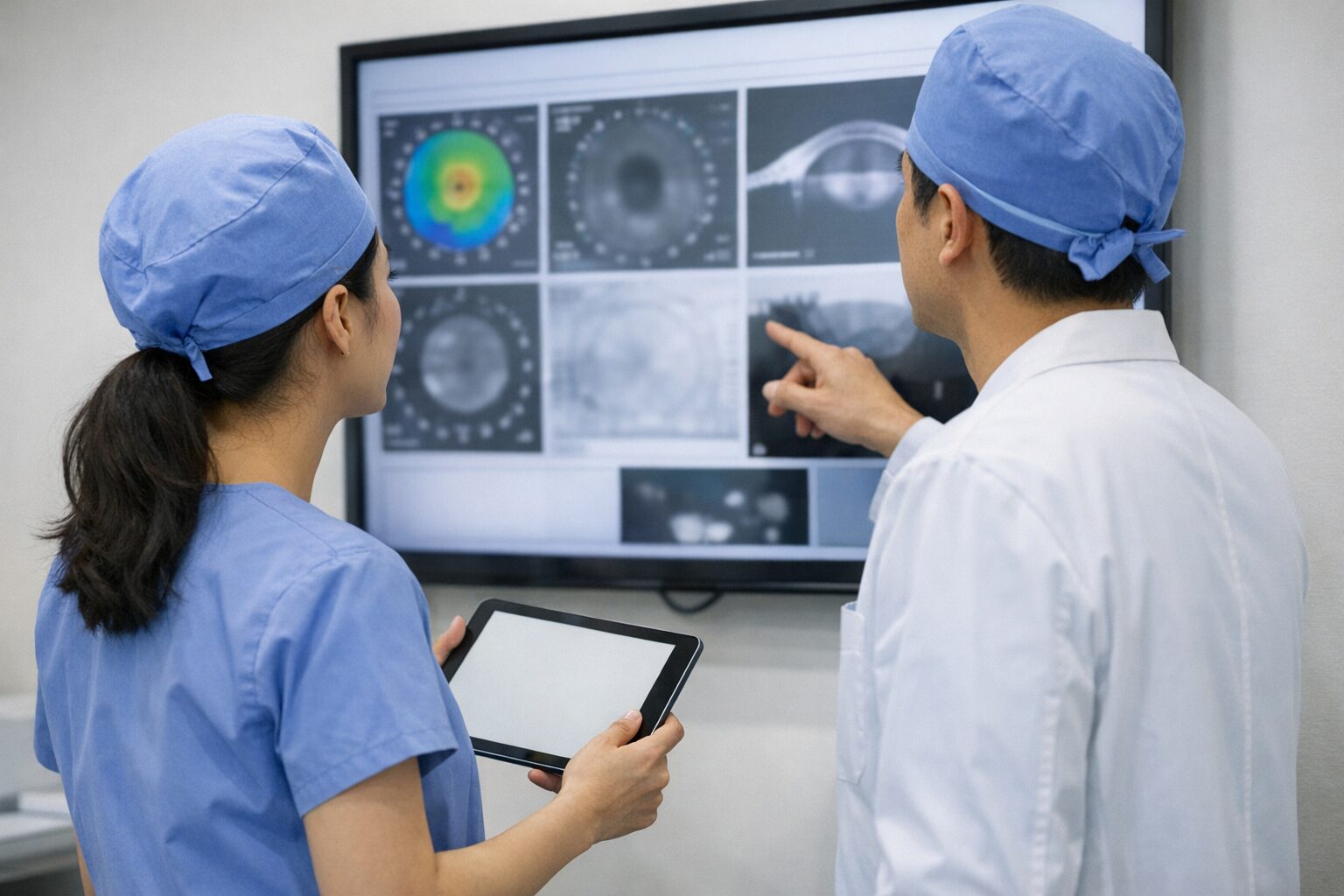
SMILE Pro vs Surface Laser: How Each Treats the Cornea
SMILE Pro removes a thin layer from inside the cornea through a small incision, while surface laser methods such as 2DAY LASEK or TransPRK reshape the cornea after its outer layer is cleared. How the…

How do SMILE Pro and surface laser correction differ? Both change the curve of the cornea to correct nearsightedness and astigmatism, but they reach the tissue from opposite directions. In SMILE Pro, a femtosecond laser shapes a thin, lens-shaped piece of tissue (a lenticule) inside the cornea, and the surgeon removes it through a small opening a few millimetres long, so most of the corneal surface stays closed. In surface laser correction, the thin outer layer of the cornea (the epithelium) is cleared first, an excimer laser reshapes the exposed tissue, and the epithelium grows back over the following days. Neither approach is better in general. Which one a surgeon suggests depends on the thickness and shape of your cornea, your prescription, and your work and sport, and that is decided at an in-person examination.
If you arrived here after searching "SMILE Pro versus TransPRK", TransPRK is one kind of surface laser treatment. At our clinic the surface option is called 2DAY LASEK Speed Up, so this article uses it as the surface example. We already have an earlier comparison of SMILE LASIK and 2DAY LASEK written for first-time patients. This one looks at SMILE Pro instead, and spends most of its time on a question that article only touched: which eyes a surface laser is usually suggested for, and why.
Two routes to the same layer of the cornea
The cornea is the clear dome at the front of the eye. Most of its thickness is a firm middle layer called the stroma, and that is where vision correction changes the curve. Above the stroma sits the epithelium, a thin layer of cells that renews itself, a little like the skin on the back of your hand. Both procedures reshape the stroma. What differs is how they get to it and what is left to heal afterwards.
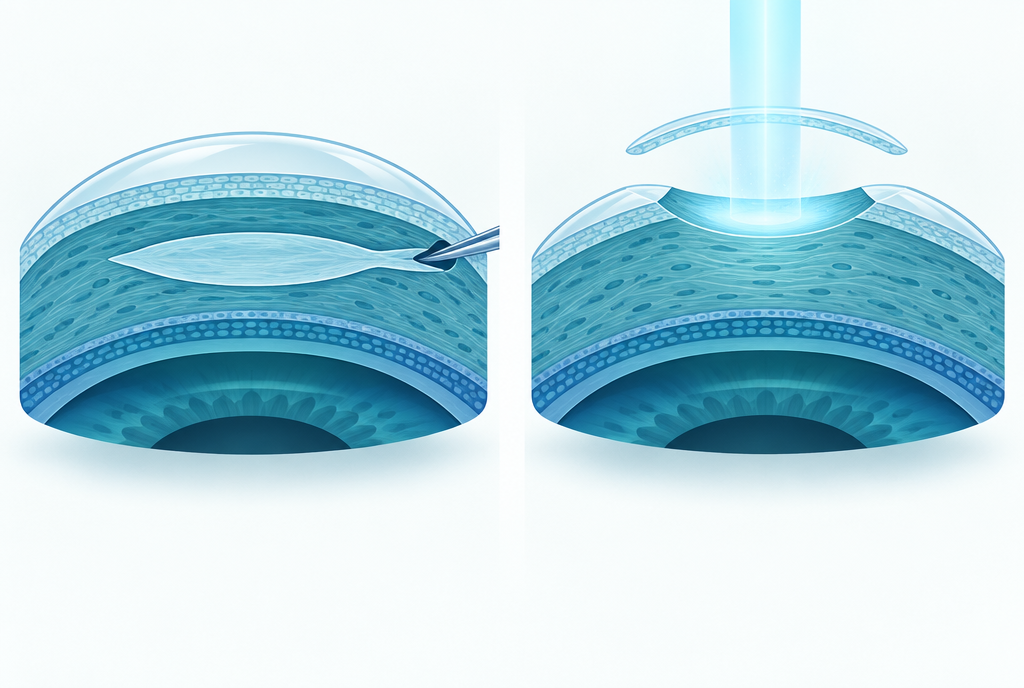
In SMILE Pro, the surface over the treatment zone is not opened. The femtosecond laser works through it, outlining the lenticule within the stroma and a small incision at its edge. The surgeon then frees the lenticule and draws it out through that incision. Removing this thin piece changes the curve of the front of the eye. No stitches are used, and the small incision closes on its own.
In surface treatment, the order is reversed. The epithelium over the treatment zone is cleared away first, and the excimer laser then removes tissue from the top of the stroma in the planned pattern. At our clinic, the epithelium is loosened and moved aside rather than cut, and a soft bandage contact lens protects the eye while new epithelium grows across. That regrowth is the main reason the first days after surface treatment feel different.
The practical result is that after SMILE Pro, healing happens mostly inside the cornea and at one small opening, while after surface treatment a whole area of the surface has to rebuild itself. Neither is a weakness in itself. They lead to different first weeks, and they suit different corneas.
Where TransPRK, PRK and LASEK fit
These names describe variations of the same surface approach. The main difference between them is how the epithelium is removed before the laser reshapes the stroma:
- PRK: the epithelium is removed with an instrument, then the excimer laser treats the stroma.
- LASEK: the epithelium is loosened and moved aside, then the laser reshapes the tissue beneath it.
- TransPRK: the excimer laser removes the epithelium itself and continues into the stroma in one sequence, without an instrument touching the cornea.
After all three, the epithelium regrows, usually under a bandage contact lens. 2DAY LASEK Speed Up is the name of the surface treatment at our clinic. The "2DAY" part refers to a recovery protocol designed to help many patients return to light daily activities within a couple of days, although full visual settling takes longer than that. If you have read about one of the other names elsewhere, most of what follows applies in much the same way, but ask any clinic you are considering exactly which method it uses.
SMILE Pro and 2DAY LASEK side by side
The table sets out how each procedure treats the cornea and what the early weeks tend to look like. The timing rows are the general planning examples from our own recovery guidance.
| Point | SMILE Pro | 2DAY LASEK (surface laser) |
|---|---|---|
| How the cornea is opened | A small incision a few millimetres long at the edge of the treated area | No incision. The epithelium over the treated area is loosened and moved aside |
| Where tissue is removed | A lenticule from inside the stroma, under a surface that stays mostly closed | The top of the stroma, directly by the excimer laser |
| What has to heal | The small incision and the space where the lenticule was | The epithelium, which grows back across the treated area over several days |
| How the first days tend to feel | Watering, grittiness and hazy vision, usually easing over the first day or two | Light sensitivity, watering, grittiness and blur that are more noticeable for the first few days. The bandage lens usually comes out around days 3 to 5 |
| Functional vision (planning example) | About 24 hours | About 4 to 5 days |
| Desk work (planning example) | Around day 2 | Around days 5 to 7 |
| Travel readiness discussed (planning example) | Around day 2 | Around days 7 to 10 |
| Vision settled (planning example) | About 1 to 3 months | About 3 to 6 months |
| Eyes it is often considered for | Stable nearsightedness and astigmatism in the treatable range, adequate corneal thickness, a healthy corneal shape | Thinner corneas, some flatter or less regular corneal shapes, high-impact sport or work, some second corrections |
Read the timing rows as examples for planning a trip, not as clearance. Your surgeon confirms work, exercise, driving and flying one by one after checking how your eyes are healing, and two people who had the same procedure on the same day can be several days apart.
When a surface laser is the one suggested
Surface treatment is not a fallback for people who "failed" the SMILE Pro assessment. For some eyes it is simply the option that fits the measurements. These are the situations in which it most often comes up during a consultation.
A cornea that is on the thin side for the correction needed. Every laser method removes tissue, and part of the reason this matters is geometry. SMILE Pro has to leave a layer of intact tissue above the lenticule as well as enough beneath it, while surface treatment works from the top down. For some corneas, the numbers allow surface treatment when they do not allow SMILE Pro. Whether that is true for your eyes comes from mapping thickness across the whole cornea, not from a single reading.
A corneal shape that calls for care. Corneal mapping sometimes shows a flatter or less regular shape for which the surgeon prefers to work on the surface. Some shape patterns point the other way, though: they suggest the cornea would not respond well to having tissue removed by any laser, and then the discussion moves to other options such as an implantable lens. We explain that difference in our article on what can rule out laser correction.
Sport and work where the eye might be hit. Contact sport, martial arts and physically demanding jobs come up often in this conversation. Neither SMILE Pro nor surface treatment creates the hinged flap used in LASIK, which is the usual concern in these cases, so for many active people both options remain open and the choice turns on the other points in this list. Some employers and services have their own rules about eye surgery for applicants. If that applies to you, find out what they require before the consultation and bring it with you.
A second correction after earlier surgery. Some people who had surgery in the past and now need a small additional correction are offered surface treatment. Whether it fits depends on what was done the first time, so bring the records of the earlier operation.
What surface treatment asks in return is a longer early recovery: more discomfort in the first few days, a bandage lens that has to be removed at the clinic, and vision that sharpens gradually over weeks. If your schedule cannot absorb that, say so at the consultation. It is a fair part of the decision, and the surgeon can explain what the alternatives would mean for your eyes.
When SMILE Pro is the one suggested
As a general guide, people who are suitable for SMILE Pro tend to have stable nearsightedness, with a prescription that has not changed significantly for at least a year, astigmatism within the treatable range, a cornea of adequate thickness and healthy shape, and no active eye disease. Age is generally the early twenties or older.
When both options fit, the difference people feel most is the first week. After SMILE Pro, the first hours usually bring watering and haze, and our planning example puts functional vision at around 24 hours. For someone flying in from Ulaanbaatar with limited leave, that shorter early stretch can reasonably weigh in the decision, as long as the measurements support it.
SMILE Pro has its own considerations as well. Temporary dryness, halos around lights at night in the early period, and the chance that a small residual prescription remains are all discussed before you decide, and some people need a further treatment to fine-tune the result. Dry eye is assessed whichever procedure is being considered. Significant dryness is usually treated first and the eyes reassessed, which changes the timing more often than the answer.
Planning a trip from Mongolia around either option
The procedure is chosen at the examination in Seoul, so it helps to plan a trip that still works if the answer is not the one you expected. Based on the planning examples above, the length of stay can differ by about a week depending on which procedure is chosen.
- With SMILE Pro, most patients plan for the examination, the surgery day and at least the next-day check, with travel readiness usually discussed around day 2.
- With 2DAY LASEK, the bandage lens is removed at the clinic around days 3 to 5, and travel readiness is usually discussed around days 7 to 10.
- A flexible return ticket, or a return date set after the examination, avoids having to choose a procedure to fit a booking.
Send your records before you book: your prescription history over several years, any corneal measurements taken at home, and records of any previous eye treatment. Our Mongolian-speaking coordinator can tell you what the preliminary review suggests and what can only be measured here.
Conditions at home matter during recovery too. The air in Ulaanbaatar is dry for much of the year, heated rooms in winter add to it, and wind and dust are common outdoors. Use your drops exactly as prescribed, consider a humidifier, and wear wraparound sunglasses outside in the first weeks, especially while the surface is still healing after 2DAY LASEK.
Questions worth asking at the examination
The examination produces the measurements; these questions help you understand what they mean for you.
- How thick is my cornea across its surface, and how much untouched tissue would each option leave?
- Does my corneal map show anything that changes the choice, or anything that rules out laser correction?
- Which option would you suggest for my eyes, and what is the main reason?
- If you suggest 2DAY LASEK, how long should I plan to stay in Seoul, and when would the bandage lens come out?
- If neither laser option suits my eyes, what would we discuss instead?
Gangnam Smile Eye Clinic (강남스마일안과) is a vision-correction and cataract clinic on Gangnam-daero, Seoul. This article was reviewed by the clinic’s medical staff for clinical accuracy. Whether SMILE Pro, 2DAY LASEK or another option suits your eyes is determined after a detailed examination and a consultation with the surgeon, and results vary from person to person.
FAQ
Is SMILE Pro or surface laser treatment better?
Neither is better in general. Both reshape the same middle layer of the cornea, but SMILE Pro removes a thin lenticule from inside the cornea through a small incision, while surface treatment such as 2DAY LASEK clears the outer epithelium and reshapes the cornea from the top. Which one suits you depends on how thick your cornea is across its surface, its shape, your prescription, your sport and work, and how much early recovery your schedule allows. The surgeon suggests one after an in-person examination.
Is recovery more uncomfortable after surface laser than after SMILE Pro?
The first few days usually are, because the epithelium has to grow back across the treated area. Light sensitivity, watering, a gritty feeling and blur are common in that period, and a bandage contact lens protects the eye until it is removed at the clinic, usually around days 3 to 5. After SMILE Pro, watering and haze usually ease over the first day or two. Discomfort varies between people. Pain that becomes severe or keeps getting worse is a reason to contact the clinic straight away.
Is TransPRK the same as 2DAY LASEK?
They belong to the same surface family but are not identical. In TransPRK the excimer laser removes the epithelium itself before reshaping the cornea. In 2DAY LASEK at our clinic, the epithelium is loosened and moved aside before the laser step. In both, the epithelium regrows over several days. If you are comparing clinics, ask each one exactly which surface method it uses.
I was told my cornea is too thin for SMILE Pro. Can I still have laser correction?
Sometimes. Surface treatment works from the top of the cornea and does not need to leave a layer of tissue above a lenticule, so for some thinner corneas it remains possible when SMILE Pro is not. It depends on thickness mapped across the cornea and on its shape. If the shape suggests the cornea would respond poorly to having tissue removed, laser correction may not be suitable at all and an implantable lens may be discussed instead. Send the measurements and the reason you were given before you plan the trip.