SmartSight vs SMILE Pro: One Lenticule Method, Two Laser Platforms
SmartSight and SMILE pro both remove a thin lenticule from inside the cornea through a small opening. They differ in manufacturer, laser platform and how the laser lines up with your eye, and your examination decides more than the product name.
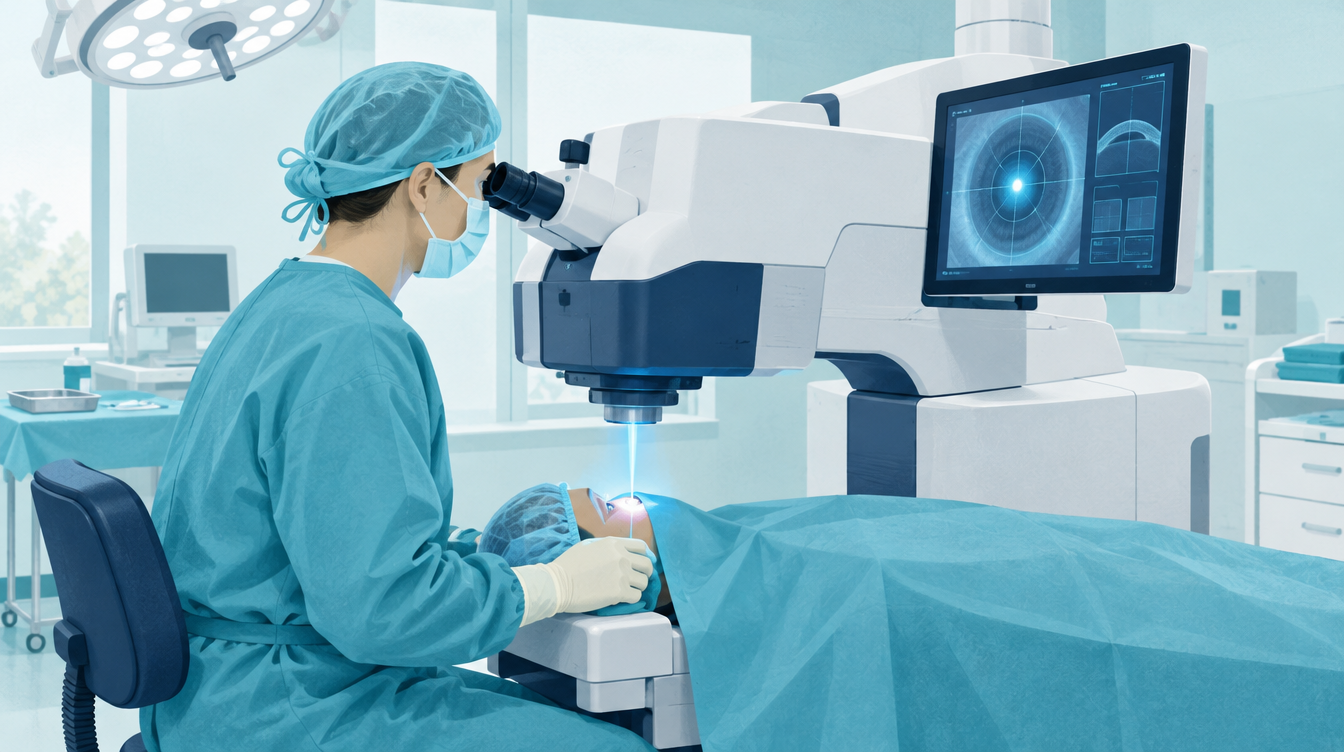
What is the difference between SmartSight and SMILE pro? They are two versions of the same method, called lenticule extraction. In both, a femtosecond laser shapes a thin, lens-shaped piece of tissue (a lenticule) inside the cornea, and the surgeon removes it through a small opening, without lifting a flap and without an excimer laser. The main difference is who makes the laser and how it is built. SmartSight is made by SCHWIND and runs on the SCHWIND ATOS laser. SMILE pro is made by ZEISS and runs on the ZEISS VISUMAX 800. The two manufacturers handle centring and eye rotation in different ways, use their own planning software, and list slightly different prescriptions in their materials. Published reviews have found lenticule extraction platforms, including these two, safe and effective in the patients studied, and the research does not show that one name gives better vision for everyone. What decides your treatment is your examination: corneal thickness and shape, the amount and pattern of your prescription, and the health of the eye surface.
One method, several product names
Lenticule extraction is now often called KLEx (keratorefractive lenticule extraction) in medical journals. Several companies make lasers that can perform it, and each company gives its version a product name. That is why search results mix names that describe the same basic idea.
| Name | Manufacturer | Laser platform | Background |
|---|---|---|---|
| SMILE | ZEISS | VisuMax (earlier generation, such as the VisuMax 500) | The earliest of these procedures. A 2021 review described it as the most established form of lenticule extraction |
| SMILE pro | ZEISS | VISUMAX 800 | ZEISS's newer version on its newer laser |
| SmartSight | SCHWIND | SCHWIND ATOS | Received European (CE) approval in 2020, according to the same review |
| SmartSight NOVA | SCHWIND | SCHWIND ATOS with CenTrax | SCHWIND describes it as SmartSight with added centring and eye-tracking functions |
| CLEAR | Ziemer | Ziemer platform | Also CE approved in 2020. Covered in our article on CLEAR and SMILE |
The names in the table are manufacturer names. A clinic may use its own procedure names on its website, and those names do not always match the manufacturer's product name. We come back to this point at the end of the article, because it applies to our own pages too.
What happens in both procedures
The steps the patient goes through are very similar on either laser. ZEISS and SCHWIND describe them in their own materials, and the outline is the same:
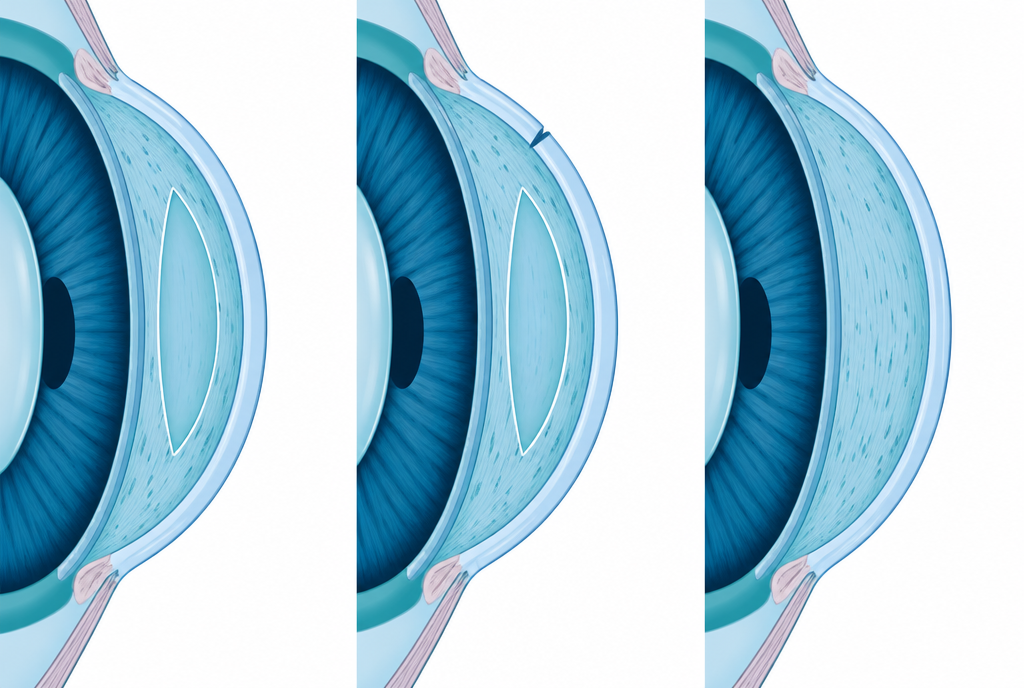
- The eye is numbed with drops, and a holder keeps the eyelids open.
- A contact surface is placed on the eye and held with gentle suction, so the eye stays still while the laser works. ZEISS describes a contact glass and notes that you may feel slight pressure. SCHWIND describes a curved patient interface.
- The femtosecond laser shapes the lenticule inside the cornea and makes a small opening at its edge. ZEISS gives the opening for SMILE pro as about 4 mm. SCHWIND describes small access incisions near the edge of the cornea without giving a figure on its product page.
- The surgeon, looking through the laser's built-in microscope, separates the lenticule and draws it out through the opening.
- With the lenticule gone, the cornea is slightly flatter in the pattern the plan calculated, and the opening closes as the eye heals.
The main shared limit follows from this: the lenticule is tissue taken from inside the cornea, so there has to be enough healthy corneal tissue to remove it safely. Both manufacturers list nearsightedness and astigmatism among what their procedure treats. The surgeon calculates the shape of the lenticule from your measurements.
Where the manufacturers describe differences
The table below sets out what each manufacturer publishes about its own system. It is a description of design, taken from the companies' product pages. It is not a test of results, and it does not mean every clinic uses every feature or software option.
| Feature | SmartSight (SCHWIND ATOS) | SMILE pro (ZEISS VISUMAX 800) |
|---|---|---|
| Centring on the eye | CenTrax uses active eye tracking that recognises the pupil and its centre, and compensates for small positioning errors that remain after docking (SmartSight NOVA) | CentraLign is a computer-assisted centring aid that uses the pupil centre and the corneal vertex during docking. CentraLign auto can move the laser head to reduce detected deviation before docking |
| Eye rotation (cyclotorsion) | SCHWIND describes automatic cyclotorsion compensation, using diagnostic images imported from its own measuring devices | OcuLign uses a still image of the iris from a diagnostic device, recalculates the treatment pattern and suggests a rotation adjustment |
| Prescriptions listed by the manufacturer | Nearsightedness and astigmatism | Nearsightedness, and farsightedness in selected markets where approved, with or without astigmatism |
| The same laser can also make LASIK flaps | Yes (FemtoLASIK) | Yes (Femto-LASIK) |
| Retreatment option described on the product page | Not described on the pages we reviewed | A software option (CIRCLE) converts the original lenticule cap into a flap so that a retreatment can be done as LASIK |
Two points help when reading this table. First, the differences are mostly in how the laser lines itself up with your eye and how it is planned, not in what happens to the cornea. Both remove a lenticule through a small opening. Second, a feature on a product page tells you what the system is designed to do. It does not tell you how a particular surgeon uses it or what result your eye will have. Ask the clinic which software version and features are used in your treatment.
Why centring and eye rotation get so much attention
Astigmatism has a direction, called its axis, which is written in degrees on your prescription. A treatment that corrects astigmatism has to be lined up with that direction. This is where the axis number on a prescription matters in surgery.
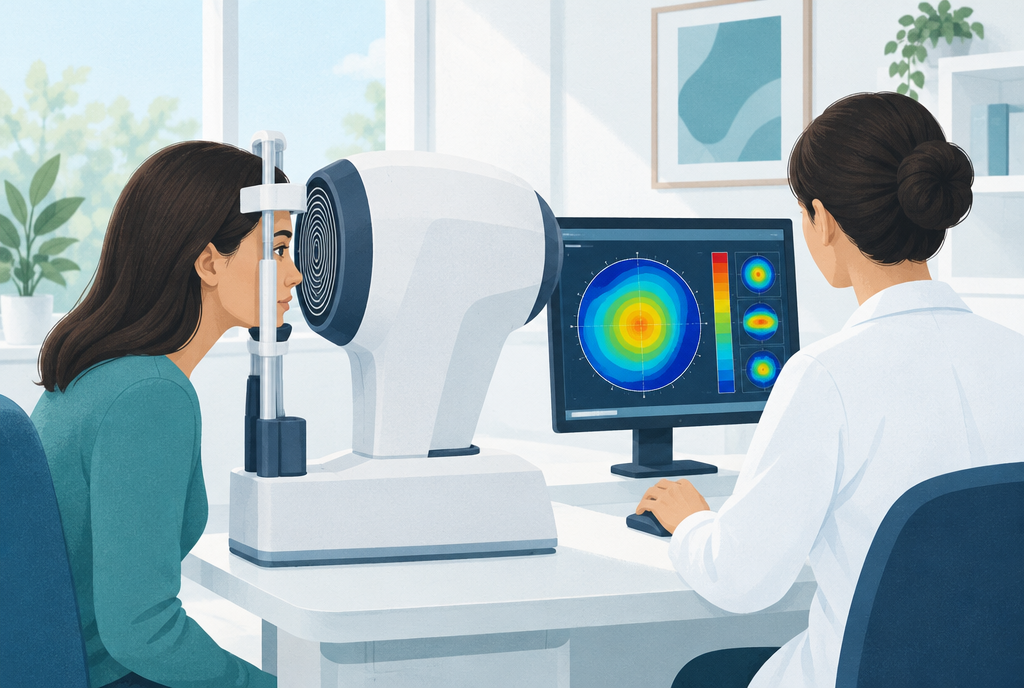
Your eye is measured while you sit upright at the diagnostic devices, and treated while you lie on the laser bed. The eye can turn slightly around its own line of sight between those two moments. That small rotation is called cyclotorsion. The treatment also has to be centred on the right point of the eye. Manufacturers use different reference points for this, such as the pupil centre, the corneal vertex or the line of sight, and these points do not always sit in exactly the same place.
This is why both manufacturers put effort into centring and rotation, and why they approach it differently. ZEISS describes assistance that works before and during docking, based on the pupil, the corneal vertex and an iris image from the measurements. SCHWIND describes eye tracking during docking that also compensates for positioning error remaining after docking. Both aim at the same thing: placing the correction where the plan says it should be.
A 2024 study in the Journal of Refractive Surgery looked at more than 5,000 eyes treated for nearsightedness and astigmatism, about half with SMILE on the older VisuMax 500 and half with SmartSight on ATOS. It measured how much correcting one part of the prescription affected another. The authors described these effects as consistently low on both lasers, and suggested that part of them may come from eye rotation. The practical lesson for a patient is simple: centring and rotation are part of planning on any laser, and they are worth asking about if you have significant astigmatism.
What the research says about results
Most studies follow one platform at a time, and few compare them head to head. Three recent publications give a fair picture of where the evidence stands:
- A 2025 review of five lenticule extraction platforms (SmartSight, CLEAR, SILK, SMILE and SMILE pro), published in Clinical Ophthalmology, found that all five showed safety, effectiveness and stable results in the studies included. Astigmatism correction was good across the platforms, and all of them changed the finer optical qualities of the eye to some degree. The review discussed differences in laser settings and in how quickly vision cleared in the first days, and noted that the shape of the cut also plays a part.
- A 2025 single-centre study compared the first patients treated with SMILE on the VisuMax 500 and with SMILE pro on the VisuMax 800. At three months, vision results were comparable between the two lasers. A newer machine from the same maker did not change three-month outcomes in that group.
- A 2026 review on dry eye after lenticule extraction found that most of the evidence comes from SMILE. Dry eye symptoms and tear film usually worsened early after surgery and then recovered gradually, often within three to six months. Evidence for the newer platforms is still limited.
Taken together, the research does not support choosing a clinic or a treatment by the product name alone. It supports looking at the examination findings, the surgeon's plan for your eyes, and how the clinic follows you up.
What actually decides your treatment
The examination decides whether lenticule extraction suits you at all, before any question of platform comes up. The same checks apply on either laser:
- Corneal thickness, mapped across the cornea, because the lenticule is tissue taken from inside it.
- Corneal shape, from corneal topography, which can reveal irregular patterns such as early keratoconus that rule out corneal laser treatment.
- Your prescription and its stability, including the amount and axis of astigmatism and whether it has changed in recent years.
- The tear film and eye surface, because dryness affects comfort and recovery after any corneal procedure.
- Pupil size and eye health, which affect night vision expectations and can change the options.
If lenticule extraction is not suitable, the conversation moves to other approaches, not to a different brand. For some thinner corneas, a surface laser may be considered. Our article on SMILE Pro and surface laser explains how the two treat the cornea differently. For other eyes, an implantable lens or no surgery at all may be the better answer.
Questions worth asking at the consultation:
- Which laser platform and which software will be used for my eyes?
- Is my cornea thick enough and evenly shaped for lenticule extraction?
- How is centring handled for my eyes, and how is eye rotation handled for my astigmatism?
- If a small prescription remains after surgery, what can be considered, and how would it be done on this laser?
- What should I expect in the first week, and when is my check-up before I fly home?
- Can I have my measurements and the treatment record in writing for my eye doctor at home?
At our clinic: names, equipment and planning a visit from Mongolia
At Gangnam Smile Eye Clinic, lenticule extraction is performed on the SCHWIND ATOS femtosecond laser. Our NEW SMILE LASIK page explains that NEW SMILE LASIK is our clinic's name for SmartSight on the ATOS laser. Our SMILE PRO page also describes treatment on the ATOS laser with CenTrax centring. So when you see "SMILE PRO" on our own procedure pages, it means our clinic's procedure on the ATOS laser. It is not the ZEISS product of the same name. If you were told about a specific laser elsewhere and want to compare, ask us which platform applies to the treatment you are considering, and we will tell you plainly.

The examination has to happen in person in Seoul. Remote diagnosis is not permitted in Korea, so a prescription sent by message cannot confirm whether you are suitable. You can still prepare:
- Send your prescriptions when you enquire, with all three numbers for each eye and older prescriptions if you have them.
- Tell us what contact lenses you wear, because they change the corneal shape and need a break before the examination.
- Keep your dates flexible until the surgeon has assessed your eyes. Corneal scans sometimes need to be repeated.
- Plan the next-day check before your flight home, as our stay guide describes.
Coordinators can guide you in English, and a Mongolian interpreter can be arranged.
Gangnam Smile Eye Clinic (강남스마일안과) is a vision-correction and cataract clinic on Gangnam-daero, Seoul. This article was written from Gangnam Smile Eye Clinic's published information and the doctors' explanations, together with the manufacturers' published product information and peer-reviewed studies. It describes products and techniques in general terms. It is not a ranking of products or clinics, a diagnosis, or a treatment recommendation for any individual. Whether lenticule extraction suits your eyes is decided by your surgeon after an in-person examination, and results vary from person to person.
FAQ
Is SmartSight the same as SMILE pro?
They use the same method but they are different products. Both are lenticule extraction: a femtosecond laser shapes a thin lenticule inside the cornea and the surgeon removes it through a small opening, without a flap. SmartSight is made by SCHWIND and runs on the SCHWIND ATOS laser. SMILE pro is made by ZEISS and runs on the ZEISS VISUMAX 800. Each has its own planning software and its own way of centring the treatment.
Does one of them give better vision?
The research does not show that one product name gives better vision for everyone. A 2025 review of five lenticule extraction platforms, including SmartSight and SMILE pro, found all of them safe and effective in the studies it included. Your result depends far more on your corneal measurements, your prescription, the surgeon's plan and your follow-up care than on the brand of laser.
Can both correct astigmatism?
Yes. Both manufacturers list nearsightedness with astigmatism among what their procedure treats, and both have systems for centring the treatment and handling eye rotation, which matters for astigmatism. Each method works only within a certain range of prescription, so whether yours fits is confirmed by the examination, not by the product name.
Which laser does Gangnam Smile Eye Clinic use?
Lenticule extraction at our clinic is performed on the SCHWIND ATOS femtosecond laser. Our NEW SMILE LASIK page describes it as SmartSight on the ATOS laser, and our SMILE PRO page also describes treatment on the ATOS laser with CenTrax centring. The clinic's own procedure names are not the same thing as the ZEISS product called SMILE pro. If you are unsure which treatment a page refers to, ask your coordinator.
Can I choose the laser platform I want?
Most clinics work with one platform for lenticule extraction, so the practical question is whether that method suits your eyes. You can always ask which laser and software will be used, and the clinic should tell you plainly. If your examination shows that lenticule extraction is not suitable, the discussion moves to other approaches, such as surface laser or an implantable lens, rather than to another brand.
Is recovery different between SmartSight and SMILE pro?
Both are flapless and follow a similar pattern. A 2026 review found that dry eye symptoms often worsen early after lenticule extraction and then recover gradually, usually within three to six months, though most of that evidence comes from SMILE and the newer platforms have been studied less. Follow your clinic's eye-drop schedule and keep your check-ups, including the next-day check before you fly home.