Can Foreigners Get Cataract Surgery in Korea, and How Long Is the Stay?
Yes, foreign patients can have cataract surgery at private eye clinics in Korea. The length of the stay is set mainly by whether one or both eyes are treated on the trip and by the checks after each o…
Can foreigners get cataract surgery in Korea, and how long is the stay? Yes. A foreign patient can be examined and treated for cataract at a private eye clinic in Korea in the same way a Korean patient is, with the same measurements, the same consent process and the same follow-up. You do not need to live in Korea or hold Korean health insurance to be seen as a private patient. The length of the stay is not a fixed number of days. It is decided by three things: whether one eye or both eyes are treated during the trip, the interval the surgeon wants between the two eyes, and the check-ups after each operation before you are cleared to fly.
Gangnam Smile Eye Clinic (강남스마일안과) is a vision-correction and cataract clinic on Gangnam-daero, Seoul. Most of our cataract patients from Mongolia are parents and grandparents travelling with a family member, so this article is written for both the patient and the person organising the trip.
What a foreign patient needs to be treated
The clinic needs the same information from you that it would need from anyone. What changes is that some of it has to travel with you.
- Your passport, for identification and the clinic record
- A list of the medicines you take, with doses, including blood thinners and anything for blood pressure or diabetes
- Any recent results for blood pressure and blood sugar, and a note of other conditions such as glaucoma or diabetic eye disease
- Your current glasses, and older records of your eye prescription if you have them
- A family member or companion, since you will not see clearly for a while after each operation
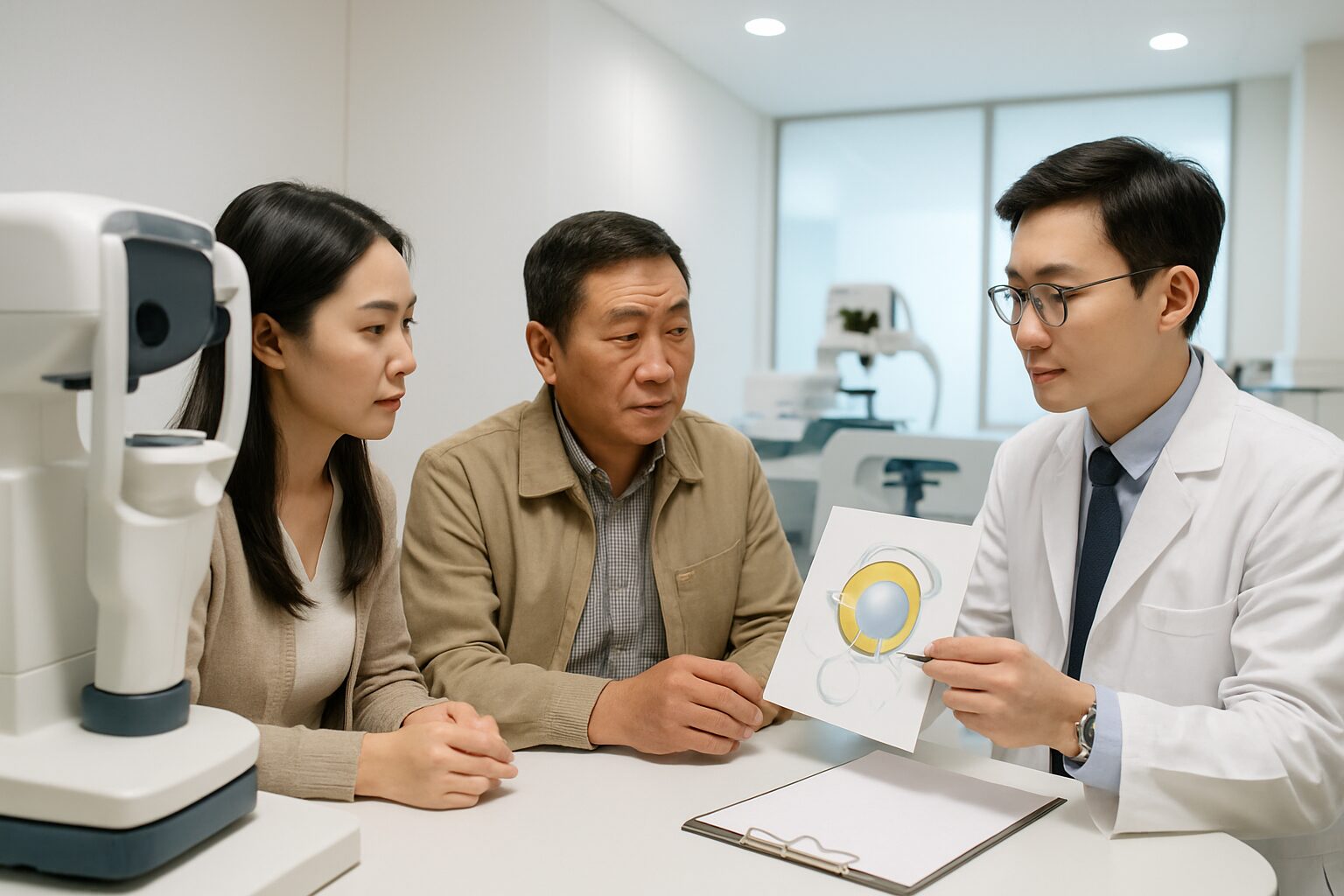
A cataract is a clouding of the eye’s natural lens. Surgery removes the cloudy lens and replaces it with a clear artificial one, called an intraocular lens. The consent conversation covers the lens choice, the risks and what to expect, and it happens in a language you understand. We arrange Mongolian-language support for this rather than relying on a relative to interpret.
What decides how long you stay
The first visit is examination and measurement. The eye is measured so that the artificial lens can be chosen for it, and the doctor confirms that cataract is what is limiting your vision rather than something else.
Our surgeons usually treat one eye at a time, with the second eye operated a short while later once the first has settled. If both eyes are to be done on the same trip, the stay covers the first operation, the checks after it, the second operation and the check after that. If only one eye is done, the stay is shorter, and the second eye is planned for a later trip or, in some cases, at home.
After each operation there are check-ups to confirm healing and to check the pressure inside the eye. Your surgeon decides when it is reasonable to fly based on those checks, not on a calendar.
So the honest answer to how long is: it depends on whether one or two eyes are treated on this visit, and the clinic gives you a written plan after the examination. Ask for that plan before you buy return tickets.
A shape for the trip, without fixed days
Think of the visit in stages rather than days. Arrival and rest. Examination and measurements, with the lens decision. The first operation, followed by a quiet day and a check. If planned, the second operation and its check. A final review and clearance to travel, with written instructions for eye drops and for what to watch for.
Between stages, the patient should avoid rubbing the eyes, keep water out of them, and wear the protective shield at night as instructed. Seoul’s hotels and taxis are easy to manage, but the companion should plan to be present for every clinic visit, since vision is blurry for a while after each operation.
After you return to Mongolia
Recovery continues at home. You leave with an eye-drop schedule and a date for the next check. Many follow-up checks can be done by an ophthalmologist in Mongolia, and the clinic tells you which findings should be reported back to Seoul. If you notice increasing pain, worsening vision or new redness, see a local eye doctor first and let us know at the same time.
If you are organising this for a parent, send the medication list and any recent eye records to our consultation channels before booking. Our Mongolian-speaking coordinator passes them to the clinical team, who can tell you whether the plan looks like one eye or two and what that means for the length of the stay.
Suitability is determined after a detailed examination and a consultation with the doctor. Results vary from person to person.
FAQ
Do I need a referral or a special visa to have cataract surgery in Korea?
The clinic does not need a referral letter. Entry requirements for Korea are set by immigration and are separate from the clinic, so check them before booking. What helps most is a medication list and any recent eye records sent ahead of time.
Are both eyes operated on the same day?
Our surgeons usually treat one eye at a time, with the second eye a short while later once the first has settled. Whether both eyes are done on one trip is decided with you after the examination, and it is the main factor in how long you stay.
Can a family member stay with the patient at the clinic?
Yes, and we recommend it. Vision is blurry for a while after each operation, so a companion should be present for every visit. Consent and instructions are given with Mongolian-language support so the relative does not have to interpret.
Can the follow-up checks be done in Mongolia?
Many can. You leave with an eye-drop schedule and a date for the next check, and the clinic tells you which findings should be reported back to Seoul. Increasing pain, worsening vision or new redness should be seen by a local eye doctor first, with a message to us at the same time.