Presbyopia vs Cataract: How to Tell Them Apart
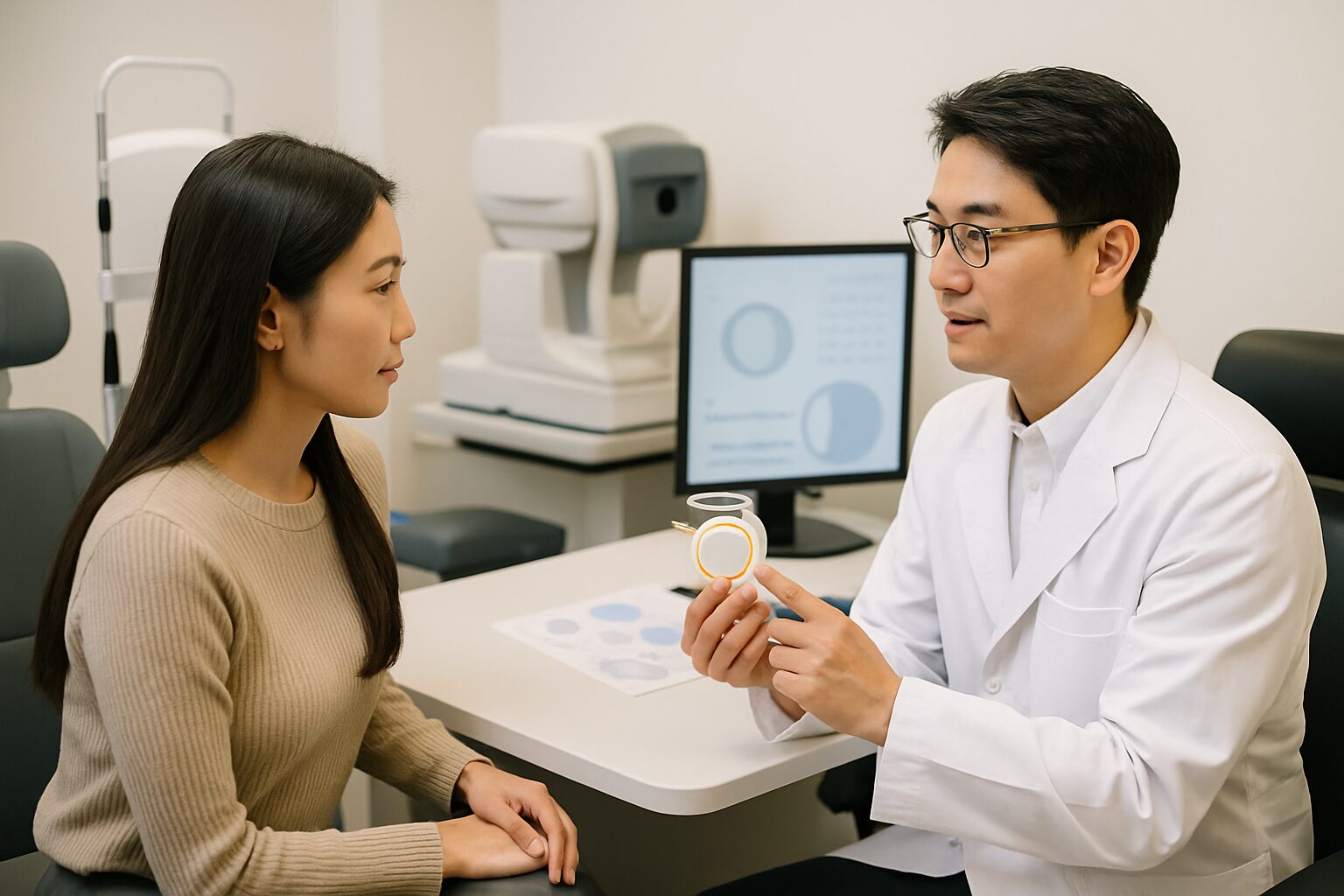
Presbyopia is the eye's lens losing its ability to focus close up. A cataract is the same lens turning cloudy. Here is how the symptoms differ, why the two often come together, and what the eye examination checks before any option is chosen.

How can you tell presbyopia from a cataract? Presbyopia is the eye's natural lens losing its ability to change focus. Small print up close becomes hard to read, distance vision stays much as it was, and reading glasses or holding the page farther away usually help. A cataract is the same lens becoming cloudy. Vision turns hazy at any distance, colours can look faded or yellowish, headlights and lamps start to glare, and new glasses help less as time goes on. Both changes begin in the 40s and become more common with every decade, so many people in their 50s and 60s have both at once. Symptoms give useful clues, but they overlap, and only an eye examination can say which change is behind the blur. A refraction shows whether the right lenses bring your vision back to sharp, a slit-lamp microscope shows whether the lens is cloudy, and a look at the retina after dilating drops checks for other causes. The options follow from those findings: glasses or contact lenses for presbyopia, and, once a cataract affects daily life, surgery that replaces the cloudy lens with an artificial lens chosen for your eyes.
Two different changes in the same lens
Behind the coloured iris sits a clear lens. When you are young it is soft and flexible, and it changes shape so the eye can switch focus from the road to a book. This ability to refocus is called accommodation.
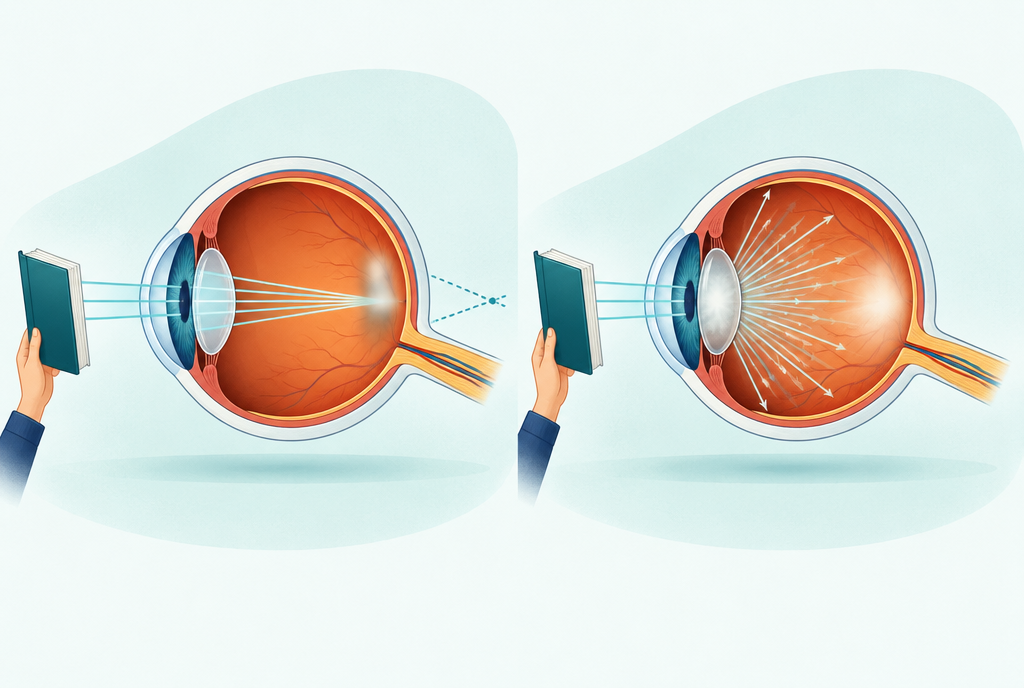
Presbyopia is the gradual loss of that ability. After about 40, the lens becomes harder and less flexible, and it can no longer change shape enough to focus close up. The US National Eye Institute (NEI) describes presbyopia as a normal part of ageing that everyone develops, usually noticed after 45. It is a refractive error, like nearsightedness, not a disease. It tends to progress for years and usually stops getting worse after about 65.
A cataract is a different process in the same lens. Proteins inside the lens start to break down and clump together, which makes part of the lens cloudy. NEI notes that this can begin around 40, and the American Academy of Ophthalmology (AAO) says people over 60 usually have some clouding, though they may not notice vision problems until years later. NEI reports that more than half of Americans aged 80 or older either have cataracts or have had cataract surgery. Light passing through a cloudy lens scatters, which is why the AAO compares it to looking through a foggy or dusty windscreen.
So presbyopia is a lens that cannot change focus, and a cataract is a lens that is no longer clear. One eye can have both.
Why the two so often arrive together
The ages overlap. Presbyopia is usually noticed in the mid-40s. Some cataract clouding is usually present after 60, even before it causes problems. There is no fixed line between the two. A person who started using reading glasses at 46 may, by 62, also have early clouding that has not yet been checked.
This is why it is easy to put every change down to needing stronger reading glasses. Families often see the same pattern in a parent: the glasses are replaced again and again, yet reading, night driving or watching television keeps getting harder. Presbyopia alone does not usually make the whole picture look dim or hazy. When that happens, the lens should be examined.
One change can even look like an improvement. Some cataracts, especially those in the centre of the lens (nuclear cataracts), make the lens focus more strongly. For a while, a person who needed reading glasses may read without them again. Eye doctors call this "second sight". The AAO explains that it is temporary: as the cataract develops, contrast and colour fade and vision becomes blurred overall. If a parent says their eyes have suddenly got better for reading after 55, that is a reason for an examination, not a reason to cancel one.
Comparing the symptoms
The table below shows which signs are more typical of each change. It is a guide to what to mention at the examination, not a way to diagnose yourself. Both conditions can be present together, and NEI points out that several of these symptoms can also come from other eye problems.
| What you notice | More typical of presbyopia | More typical of cataract |
|---|---|---|
| Small print up close is blurred, distance looks normal | Yes, this is the main sign | Possible, but cataracts often blur distance too |
| Holding the phone or book farther away helps | Yes | Usually not |
| Tired eyes or headache after close work | Yes | Not a typical sign |
| Vision looks hazy, cloudy or filmy at any distance | No | Yes |
| Colours look faded, dull or yellowish | No | Yes |
| Glare or halos around headlights, lamps or sunlight | No | Yes, often worse at night |
| Double or ghost image in one eye | No | Possible |
| Glasses prescription keeps changing | The reading power increases slowly over the years | Changes can come more often, and new glasses help less |
| Reading suddenly easier without reading glasses after 55 | No | Possible ("second sight") |
| Needing more light to read | Common | Common, so this sign alone does not separate them |
Two points help when reading the table. NEI notes that a cataract can be in one eye or both, and that it cannot spread from one eye to the other, so comparing the eyes one at a time is a useful note for the doctor. Both changes usually progress over months or years. A sudden change in vision is not the usual pattern for either and should be seen by an eye doctor promptly, without waiting to plan a trip.
Simple observations to bring to the examination
You cannot confirm a cataract at home, but a few notes made before the visit help the doctor understand what has changed. This is especially useful when a family member is organising the visit for a parent.
- Which distances are blurred. Only the phone and books, or also signs, faces across a room and the television?
- Whether reading glasses still work. Do they make small print sharp, or does it still look soft or washed out with them on?
- Light and night vision. Is night driving harder because of glare? Does bright sunlight feel uncomfortable?
- Colours. Do whites look slightly yellow, or do colours seem less bright than before?
- One eye at a time. Cover each eye in turn while looking at the same text or a distant sign. Is one eye clearly worse?
- The history of the glasses. When were they last changed, and did the new pair help as expected?
- General health. NEI lists diabetes, smoking, long sun exposure, steroid medicines and earlier eye injury or surgery among the things that raise the risk of cataract. Write down medicines with their doses.
Bring the current glasses and any older prescriptions. These notes do not replace any test. They help the doctor choose where to look first.
What the eye examination checks
An examination for blurred vision in middle age looks at three questions. How much of the blur can glasses correct? Is the lens cloudy, and does the cloudiness explain the vision? Is anything else, such as the retina or optic nerve, involved? The tests below are the usual ways to answer them. Your doctor decides which ones you need.
| Test | What happens | What it tells the doctor |
|---|---|---|
| Visual acuity | You read letters on a chart, one eye at a time, at distance and up close | How sharp your vision is, with and without glasses |
| Refraction | An automated device measures the eye, then lenses are adjusted while you compare | Your prescription, including the reading power presbyopia needs, and whether the right lenses restore sharp vision |
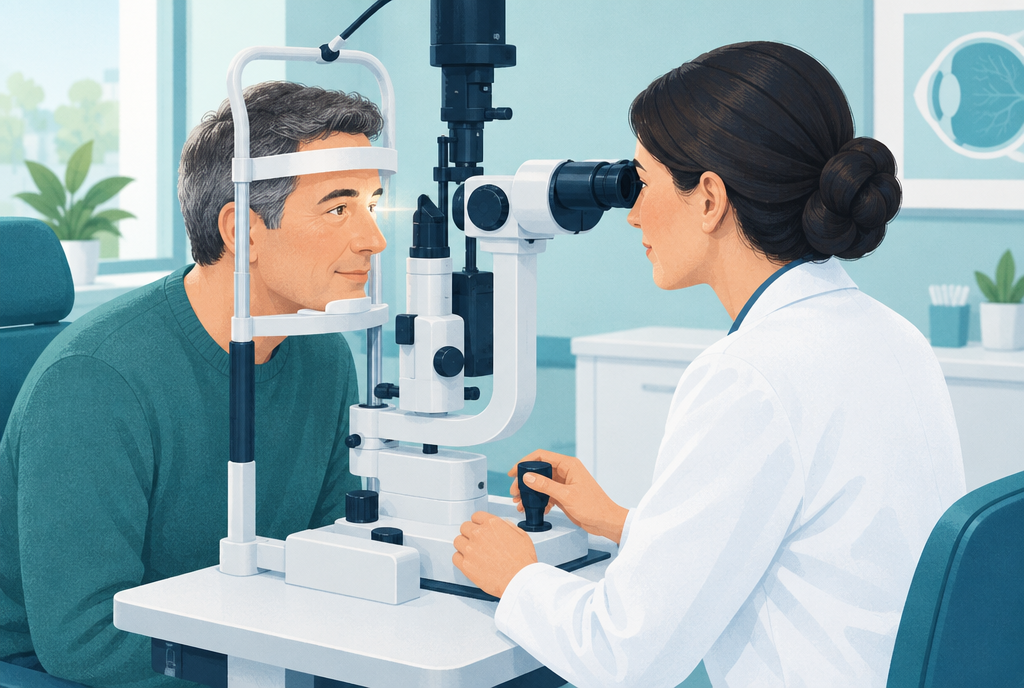
| Slit-lamp examination | A microscope with a thin beam of light looks at the front of the eye | Whether the lens is cloudy, how much, and in which part |
| Eye pressure (tonometry) | A puff of air or a light touch measures the pressure inside the eye | Screening for glaucoma |
| Dilated retinal examination | Drops widen the pupil so the doctor can see the back of the eye | The health of the retina and optic nerve. An OCT scan may be added to image the retinal layers |
| Biometry and corneal measurements | A device measures the length of the eye and the curve of the cornea, and corneal scans map its shape | Done when surgery is being considered, to calculate the power of the artificial lens and plan for astigmatism |
Presbyopia is confirmed mainly through near vision and refraction. If the right reading lenses make small print sharp and the rest of the eye is healthy, presbyopia explains the symptom. A cataract is confirmed when the slit lamp shows clouding and the doctor judges that it accounts for the reduced vision. That second step matters. The AAO notes that cataract surgery cannot restore vision lost to other conditions, such as macular degeneration, glaucoma or diabetic eye disease, so the retina and optic nerve are checked before any decision.
The dilating drops can blur vision and make the eyes sensitive to light for a few hours, according to NEI. Bring sunglasses, do not plan to drive, and avoid booking anything that needs sharp reading straight afterwards. If you have glare symptoms, the doctor may also test your vision with a bright light shining from the side, which shows how much glare affects you in practice.
At our clinic, the examination equipment listed on our Korean website includes autorefractors, a slit-lamp microscope, a tonometer, OCT imaging with retinal photography, Pentacam corneal tomography and an IOLMaster 700 optical biometer, described there as the device for calculating artificial lens power. Which of these are used for you depends on your symptoms and the doctor's assessment.
What the findings mean for your options
The examination result, not the name of the symptom, sets the next step. The table summarises the usual direction for each finding.
| Examination finding | What it usually means | Options usually discussed |
|---|---|---|
| Presbyopia, lens clear | The lens is healthy but no longer focuses close up | Reading glasses, bifocal or progressive glasses, contact lenses, and in some cases surgical options with their own trade-offs |
| Early cataract that does not limit daily life | Surgery is not needed yet | Updated glasses, brighter reading light, anti-glare sunglasses and regular checks |
| Cataract that limits reading, driving or other daily tasks | Removing the cloudy lens is the treatment | Cataract surgery with an artificial lens (IOL) chosen for your eyes and needs |
| Cataract with presbyopia, with or without astigmatism | Both can be considered in the choice of lens | Monofocal, multifocal, extended depth of focus (EDOF) or toric lenses, depending on the examination |
Presbyopia without cataract. The AAO lists reading glasses, bifocal, trifocal or progressive glasses and contact lenses, including monovision and multifocal lenses, as the usual corrections. Surgical approaches also exist, and each involves trade-offs that need a careful conversation. Our article on monovision and presbyopia correction explains how that consultation works. Our cataract page states it plainly: presbyopia alone does not mean that cataract surgery is needed.
Early cataract. NEI explains that surgery is the only treatment that removes a cataract, but most people do not need to rush. Early on, new glasses, brighter light and anti-glare sunglasses can help, and waiting usually does not harm the eye or make surgery harder later. Regular checks show when the cataract starts to interfere with daily life.
Cataract that affects daily life. In surgery, the cloudy natural lens is removed through a very small opening and an artificial intraocular lens (IOL) is placed in its position. Before surgery, the eye is measured so the lens power can be set. The AAO describes the main lens types: monofocal lenses focus at one distance, usually far, so most people still wear glasses for reading. Multifocal and EDOF lenses are designed to reduce dependence on glasses at more than one distance. Toric lenses also correct astigmatism. Our clinic discusses multifocal, EDOF and toric lens options, and introduces LENSAR and CENTURION equipment for cataract care. Not everyone suits a multifocal lens. Conditions of the retina, optic nerve or cornea can change which lens is appropriate. Halos or glare around lights can occur, and glasses may still be needed for some tasks. Our article on presbyopia and multifocal lens options with cataract treatment covers the lens types in more detail.
Questions worth asking at the consultation:
- Is my blur coming from presbyopia, cataract or both, and how sure is that from today's tests?
- Is the cataract affecting my vision enough that surgery makes sense now, or can it be watched?
- Is my retina and optic nerve healthy enough for the lens types we are discussing?
- At which distances should I expect to need glasses with each lens option?
- If both eyes need surgery, what order and interval do you recommend?
- Can I have my measurements and examination results in writing for my eye doctor at home?
Planning an examination in Seoul for a parent
The diagnosis has to be made in person. Remote diagnosis is not permitted in Korea, and an enquiry by message cannot confirm whether a cataract is present or whether surgery is appropriate. You can still prepare well before travelling:

- Send what you have when you enquire: the current glasses prescription, older prescriptions, and any eye reports from home.
- Prepare a medicine list with doses, including blood thinners and medicines for blood pressure or diabetes, and recent blood pressure and blood sugar results if available.
- Bring a companion and sunglasses to the examination, because the dilating drops blur vision for a few hours.
- Keep the return date flexible until the examination is done. If surgery is planned, our surgeons usually treat one eye at a time, and the length of the stay depends on whether one or both eyes are treated on the trip. Our guide to cataract surgery for foreign patients and the length of stay explains how that plan is made.
Coordinators can guide you in English, and a Mongolian interpreter can be arranged. More about examination and lens planning is on our cataract and presbyopia page.
Gangnam Smile Eye Clinic (강남스마일안과) is a vision-correction and cataract clinic on Gangnam-daero, Seoul. This article was written from Gangnam Smile Eye Clinic's published information and the doctors' explanations, together with patient information from the US National Eye Institute and the American Academy of Ophthalmology. It explains general differences between two common eye changes. It is not a diagnosis or a treatment recommendation for any individual. Whether your symptoms come from presbyopia, cataract or another condition, and which option suits you, is decided by a doctor after an in-person examination, and results vary from person to person.
FAQ
Can you have presbyopia and a cataract at the same time?
Yes, and it is common. Both involve the eye's natural lens and both become more frequent after 40. Presbyopia is the lens losing its ability to focus close up, and a cataract is the lens becoming cloudy, so one eye can have both. An eye examination shows how much of the blur comes from each, which matters because they are managed differently.
Will stronger reading glasses fix a cataract?
Not in the long run. Early on, an updated prescription, brighter light and anti-glare sunglasses can help you see better. Glasses cannot make a cloudy lens clear, though, so as a cataract develops, new glasses help less and vision stays hazy even with the right lenses. When a cataract starts to limit reading, driving or other daily tasks, surgery is the treatment that removes it.
Does cataract surgery also correct presbyopia?
It can be part of the plan. In cataract surgery the cloudy lens is replaced with an artificial lens, and the lens type affects focus at different distances. Monofocal lenses usually focus far, so reading glasses are still needed. Multifocal and extended depth of focus lenses are designed to reduce dependence on glasses at more than one distance, but they do not suit every eye, and glasses may still be useful for some tasks. Presbyopia alone does not mean that cataract surgery is needed.
My parent can suddenly read without reading glasses. Is that good news?
It is worth an examination. Some cataracts in the centre of the lens make the eye focus more strongly for a while, so a person who needed reading glasses may read without them again. Eye doctors call this second sight. It is temporary, and as the cataract develops, contrast and colours fade and vision becomes blurred overall.
Can a cataract come back after surgery?
The cataract itself does not come back, because the natural lens has been removed. Months or years later, the thin capsule that holds the artificial lens can become cloudy and make vision hazy again. This is called a secondary cataract or posterior capsule opacification. NEI reports that up to 2 in 5 people develop it after cataract surgery, and it is treated with a laser that opens the cloudy capsule.
Can the clinic tell presbyopia from cataract using a prescription or photo sent online?
No. Remote diagnosis is not permitted in Korea, and a prescription or photo cannot show whether the lens is cloudy or whether the retina is healthy. You can send your prescriptions, eye reports and medicine list when you enquire so the visit can be planned, but the answer comes from an in-person examination in Seoul.