Pregnancy, Breastfeeding and Vision Correction: When to Plan Surgery
Vision correction is usually postponed during pregnancy and breastfeeding, because the cornea and prescription can change for a while. Here is what the sources say about waiting periods, what to check at each stage, and how to plan an examination once your eyes have settled.

If you are pregnant or breastfeeding, the usual advice is to wait before having vision correction. That applies to laser procedures such as SMILE PRO, NEW SMILE LASIK and 2DAY LASEK, and to implantable lenses such as EVO ICL. Pregnancy hormones and fluid changes can alter the cornea and your glasses prescription for a while, and the eye surface is often drier. A correction planned on those measurements may not match the prescription your eyes settle back to. There is no single waiting period that every eye doctor uses. Ophthalmology sources commonly mention about three to six months, but some count from the birth and others from the day breastfeeding stops. What decides the timing in the end is an examination showing that your measurements are stable again, ideally compared with a prescription from before the pregnancy. If you are only planning a pregnancy, the question is different: surgery is not ruled out, but the timing is worth discussing with your surgeon, because doctors' views on the gap differ.
What pregnancy and breastfeeding can do to your eyes
The American Academy of Ophthalmology (AAO) explains that the eyes can change during pregnancy because of fluid retention, increased blood volume and shifting hormones. These changes are usually temporary. They tend to settle after the baby is born or after a breastfed child is weaned, and they are often small enough that new glasses are not needed.
Several parts of the eye are involved.
The cornea. The cornea is the clear front window of the eye, and it is the part that laser vision correction reshapes. An AAO review for eye doctors notes that corneal thickness and curvature increase in the second and third trimesters, probably because of water retention. Studies do not all agree on how large this change is. Some found a measurable difference and others found almost none. One study found that the corneal curve stayed changed in women who were breastfeeding and returned after they stopped.
The prescription. An ophthalmologist answering on the AAO website writes that glasses and contact lens prescriptions often change during pregnancy, that similar changes occur during breastfeeding, and that there is no way to tell in advance which changes will reverse and which will remain. In one survey of pregnant women, about one in seven reported a change in vision. In those women, the eyes had become slightly more nearsighted, by just under one dioptre on average, and returned to their earlier level by three months after delivery.
The tear film. Hormonal changes can reduce tear production and cause dry eye. One study found lower tear production in most women in the third trimester. The cornea can also become less sensitive.
Contact lenses. Because of the drier surface and the corneal changes, contact lenses often feel less comfortable. Studies have reported difficulty with lenses in about a quarter to 30 percent of pregnant women who wear them.
Eye pressure. Pressure inside the eye tends to fall slightly during pregnancy and usually returns to its usual level after the birth.
These changes are part of how the body adapts to pregnancy. For surgery planning, the key point is that measurements taken during this period may describe a temporary state.
Why vision correction is usually postponed
Vision correction is planned on the prescription and corneal measurements taken at the examination. If those numbers are temporarily shifted, the correction is set to a moment rather than to your settled eyes. When the eye returns to its earlier shape, the result may no longer fit, and further treatment could be needed. Our article on age and a stable prescription explains why stability matters for every patient, not only during pregnancy.
This concern appears consistently in official guidance:
- The US Food and Drug Administration (FDA) lists people who are pregnant or breastfeeding among those more likely to have an unstable prescription, and advises them to discuss the extra risks with their doctor before LASIK.
- The AAO review states that corneal refractive surgery is not advised during pregnancy, and that the dry eye common in this period can slow healing after any corneal procedure.
- The FDA-approved patient information for EVO ICL lists being pregnant or nursing among the situations in which the lens should not be implanted.
- Our clinic's 2DAY LASEK page states that pregnancy may make any laser correction unsuitable, and that eligibility is confirmed only after a full in-person examination.
There are other reasons to wait. The AAO notes that pregnancy can bring blood pressure problems such as preeclampsia, and diabetes can develop or worsen. Both can affect the eyes, and any change of that kind needs care first. Surgery is also followed by prescribed eye drops. Whether a particular medicine suits you during pregnancy or breastfeeding is a question for your eye surgeon together with your obstetrician or your baby's doctor. This article does not give a general answer to it.
How long to wait after the birth and after breastfeeding
Ophthalmology sources do not give one fixed number, and you may hear different figures from different clinics. Here is what the sources we checked say:
- The AAO review advises delaying corneal refractive surgery, and even a change of glasses, until three to six months after the delivery, when the prescription has stabilised.
- A review of LASIK and PRK contraindications, cited in the AAO's EyeWiki, recommends postponing surgery for three to six months after pregnancy and after breastfeeding has stopped.
- The corneal curvature study mentioned above found that the change continued during breastfeeding, which is why many doctors prefer to count from the end of breastfeeding rather than from the birth.
So the counting point differs, and the numbers are a starting guide rather than a rule. The deciding factor is your examination. Your doctor compares the prescription and corneal measurements with your earlier records and judges whether they have settled. A prescription from before the pregnancy is especially useful here, because it shows where your eyes are likely to return. If it is missing, two measurements taken some time apart show the same thing more slowly.
If your examination suggests waiting longer, it does not mean that you cannot have surgery. It means the timing is not right yet. Our article on what can rule out laser correction before you fly explains how timing reasons differ from findings that change which procedure is suitable.
Stage by stage: what to check and what to ask
The table summarises the usual approach at each stage. It is general information. Your own doctors decide what applies to you.
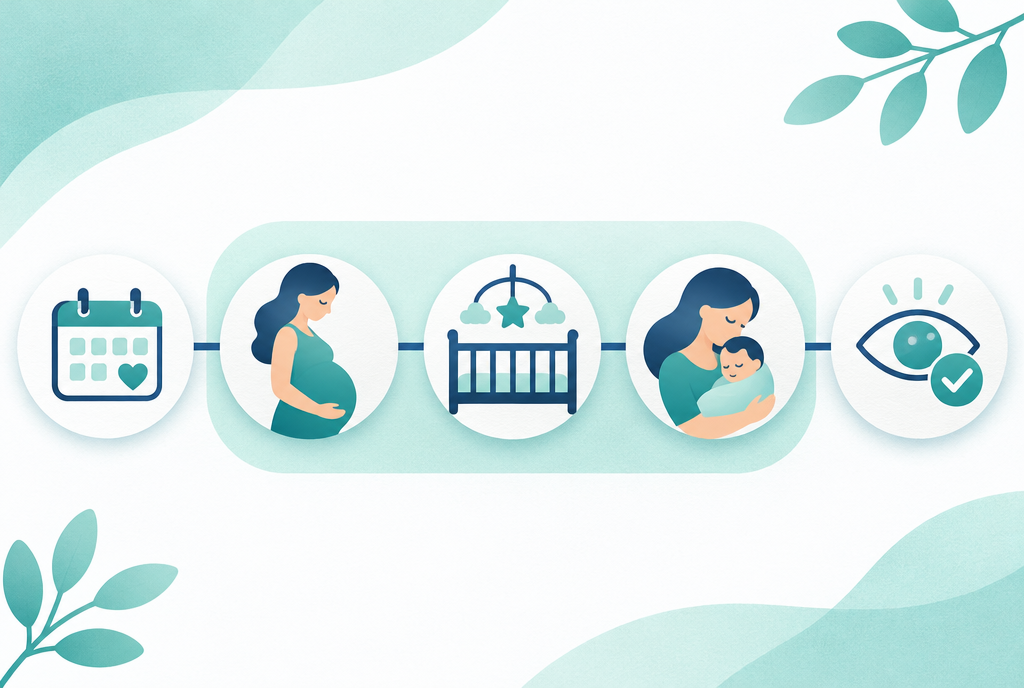
| Stage | What is usually advised | What to check or keep | What to ask your doctor |
|---|---|---|---|
| Planning a pregnancy | Surgery is not ruled out if you are suitable and can complete healing and follow-up. Views on the gap before pregnancy differ | Your current prescription and how it has changed over recent years. If you have diabetes, an eye examination before conception | How long should I allow between surgery and trying to conceive? What follow-up visits will I need, and when? |
| Pregnant | Vision correction is postponed. Glasses are usually the simplest option | Comfort with contact lenses, dry eye, and any sudden blurring, flashes or spots | Which lubricating drops are suitable now? Is this vision change something to check today? |
| Soon after the birth | Still waiting, because the prescription may be shifting back | Whether vision feels different from before the pregnancy | Is this blur expected, or should I have an eye examination now? |
| Breastfeeding | Usually still postponed. Many doctors count the waiting period from the end of breastfeeding | Dry eye, and any medicines you take | Are any examination or surgery medicines a concern while I am breastfeeding? |
| After breastfeeding ends | Plan an examination after some months, once the prescription has had time to settle | Your pre-pregnancy prescription, the date the baby was born and the date breastfeeding stopped | Have my measurements returned to my earlier level? Is it worth repeating them before deciding? |
Two points help when using the table. First, keep a copy of every prescription from before and during pregnancy, even if you do not change glasses. Second, any sudden change in vision during pregnancy or after the birth is a medical question first. It is not a planning question for surgery.
If you are planning a pregnancy
This is the stage where doctors' advice differs most.
One ophthalmologist answering on the AAO website wrote that pregnancy timing after LASIK is not restricted once the eye has healed well, and that the main concern is the dry eye some women develop during pregnancy. The EyeWiki article reports that other authors suggest waiting six months to one year after refractive surgery, or until a stable prescription has been documented, before becoming pregnant. Both views come from eye specialists. The difference reflects limited research rather than one side being careless.
EyeWiki also describes a small number of case reports in which pregnancy hormones were linked with weakening of the cornea years after LASIK, in people who may already have had risk factors. A causal link has not been established. It is one more reason that corneal shape and thickness are measured carefully before any laser procedure, and a reason to mention your family plans at the consultation.
Practical steps if a pregnancy is likely in the next year or two:
- Tell your surgeon at the consultation. This is a normal question, and it helps the doctor plan the timing with you.
- Allow time for healing and follow-up. Plan the trip so you can attend the follow-up visits your surgeon schedules, including any after you return home.
- If you become pregnant soon after surgery, tell both your eye surgeon and your obstetrician, and ask before changing or stopping any prescribed eye drops.
Looking after your eyes while you wait
Waiting does not mean doing nothing. These steps can make the months before surgery more comfortable.
- Glasses as the main correction. If your contact lenses feel scratchy or dry, wearing glasses more often is usually the easiest change. The AAO notes that contact lenses may feel less comfortable when dry eye is present.
- Ask before using eye drops. The AAO suggests talking to your ophthalmologist about lubricating drops and other dry eye treatments that are suitable during pregnancy.
- Do not rush to change glasses for a small shift. Minor changes during pregnancy often settle. If your vision is not good enough for driving or work, have an eye examination rather than guessing.
- Know which changes need attention now. The AAO advises contacting your doctor right away if vision becomes very blurry, because it can be a sign of high blood pressure or pregnancy-related diabetes. Flashing lights, spots or double vision also deserve a prompt call to your obstetrician or eye doctor. Blurred vision that continues after the birth is a reason to see an ophthalmologist.
- If you have diabetes, the AAO's guidance for eye doctors recommends an eye examination before conception and in the first trimester, with further checks depending on what is found.
The AAO review notes that most pregnancy-related eye changes are reversible. Knowing the warning signs means you can act quickly if one does appear.
Planning your examination in Seoul
A trip to Seoul for vision correction makes most sense once the waiting period is over and your prescription has had time to settle. You can still enquire earlier and prepare.
- Send your records when you enquire: your pre-pregnancy prescription, your current one, contact lens details, and any eye reports from home.
- Give the key dates: when your baby was born and when breastfeeding stopped, or when you expect it to stop.
- List your medicines, including any hormonal medicines, with doses.
- Keep the plan flexible. If the examination shows your measurements are still moving, the doctor may suggest waiting and measuring again. The trip still gives you a measured baseline for the next decision.
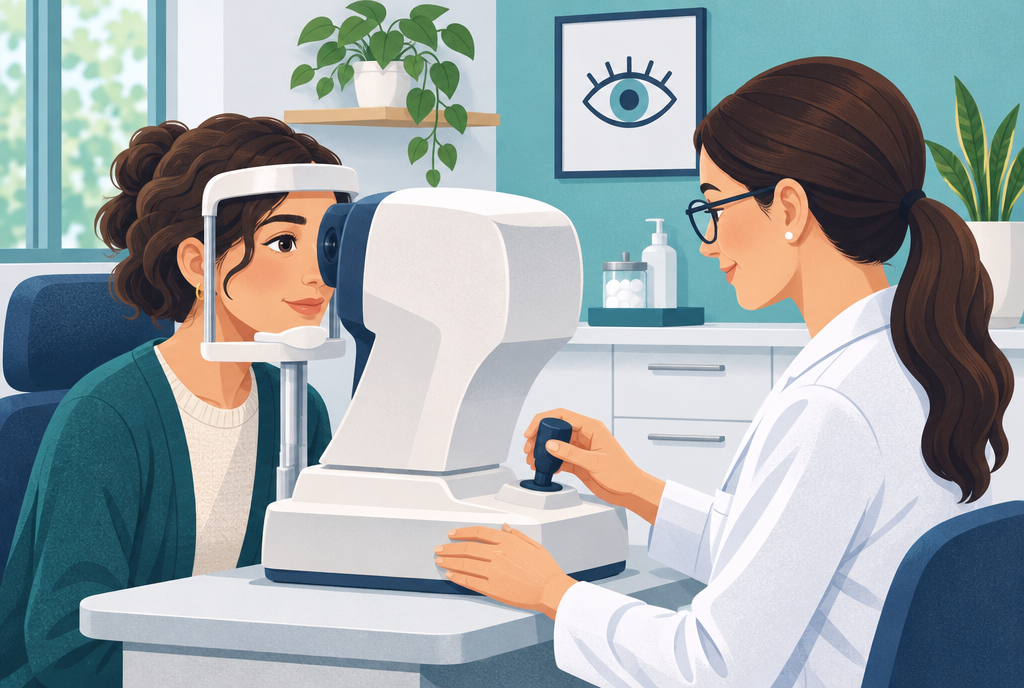
Remote diagnosis is not permitted in Korea, so whether and when you are suitable is decided at the in-person examination in Seoul. The examination checks your prescription, corneal shape and thickness, tear film and overall eye health before any procedure is discussed. Coordinators can guide you in English, and a Mongolian interpreter can be arranged.
Gangnam Smile Eye Clinic (강남스마일안과) is a vision-correction and cataract clinic on Gangnam-daero, Seoul. This article was written from Gangnam Smile Eye Clinic's published information and the doctors' explanations, together with information from the American Academy of Ophthalmology and the US Food and Drug Administration. It explains general timing considerations for vision correction around pregnancy and breastfeeding. It is not a diagnosis or a treatment recommendation for any individual, and it does not replace advice from your obstetrician. Whether and when vision correction suits you is decided by a doctor after an in-person examination, and results vary from person to person.
FAQ
Can I have SMILE PRO or LASIK while I am breastfeeding?
It is usually postponed. Glasses and contact lens prescriptions can change during breastfeeding as well as during pregnancy, and the US FDA lists breastfeeding among the situations in which the prescription is more likely to be unstable. The eye surface also tends to be drier. Many doctors therefore wait until some months after breastfeeding has stopped and the measurements have settled. The final decision is made at an in-person examination.
How long after giving birth should I wait before vision correction?
There is no single figure that every eye doctor uses. Ophthalmology sources commonly mention about three to six months, but some count from the birth and others from the end of breastfeeding. The deciding factor is an examination showing that your prescription and corneal measurements are stable, ideally compared with a prescription from before the pregnancy.
Is it a problem to become pregnant soon after vision correction?
Doctors' views differ. One ophthalmologist answering on the American Academy of Ophthalmology website wrote that pregnancy timing is not restricted once the eye has healed well, with dry eye as the main concern. Other authors suggest waiting six months to a year, or until the prescription is documented as stable. Tell your surgeon about your plans at the consultation, and if you become pregnant after surgery, tell both your eye surgeon and your obstetrician before changing any prescribed eye drops.
My vision changed during pregnancy. Will it go back?
Often it does. The AAO explains that pregnancy-related eye changes are usually temporary and tend to settle after the birth or after weaning, and many are small enough not to need new glasses. Some prescription changes can remain, and it is not possible to tell in advance which ones. If your vision becomes very blurry, or you notice flashing lights, spots or double vision, contact your doctor right away rather than waiting.