Astigmatism and Vision Correction: Options and What the Exam Measures
In many people, astigmatism can be corrected in the same treatment as nearsightedness, by laser or with a toric lens. Whether yours fits depends on its amount, its pattern and your cornea.
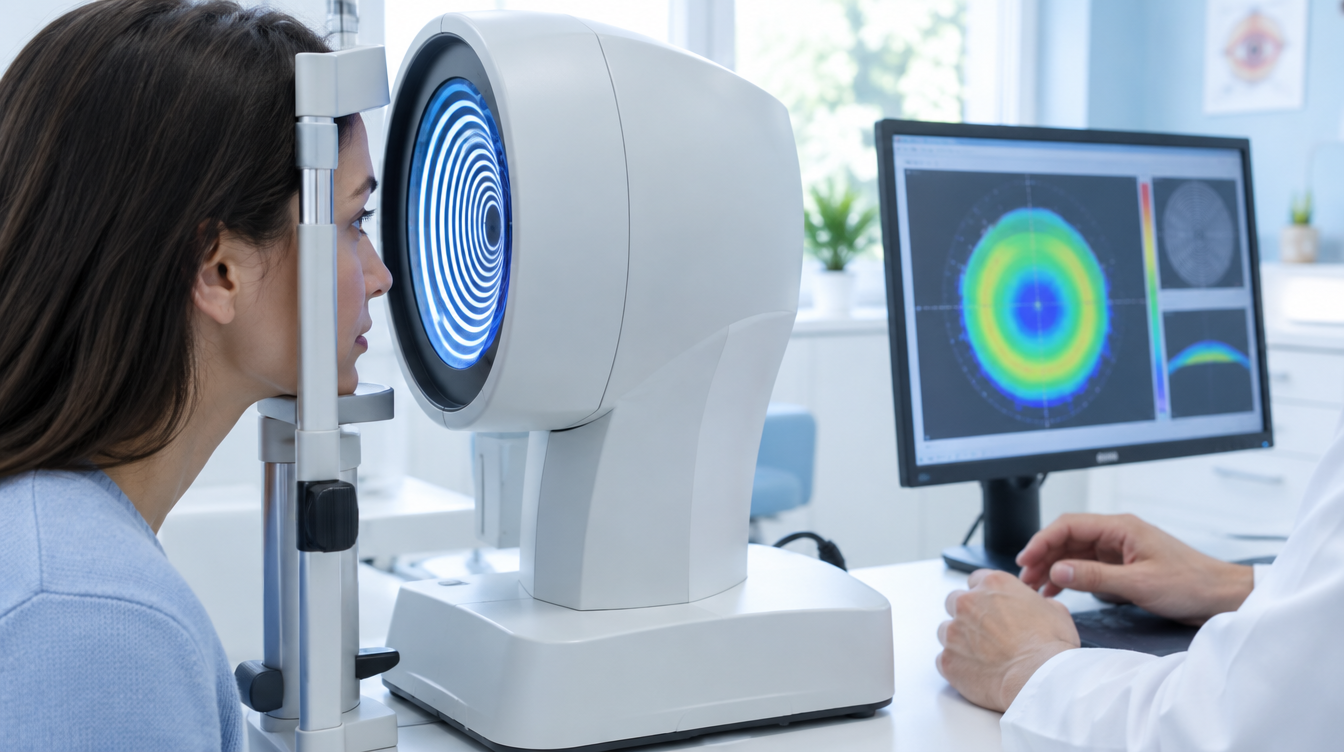
Can astigmatism be corrected with vision correction surgery? In many people, yes. Astigmatism is usually corrected in the same treatment as nearsightedness. Laser methods such as LASIK, lenticule extraction (SMILE-type surgery) and surface laser (LASEK or PRK) reshape the cornea, and the treatment plan includes the astigmatism. Implantable lenses come in toric versions that carry an astigmatism correction inside the eye, and lens surgery for cataract can use a toric lens as well. Whether your astigmatism fits one of these depends on four things the examination measures: how much astigmatism you have, whether its pattern is even or irregular, whether it sits mainly in the cornea or in the lens inside the eye, and how thick and healthy your cornea is. Having astigmatism does not on its own make surgery suitable or unsuitable. The surgeon decides after examining your eyes in person.
What astigmatism is, in plain words
The cornea is the clear front window of the eye. Together with the lens behind it, it bends light so that it lands in one sharp point on the retina at the back of the eye.
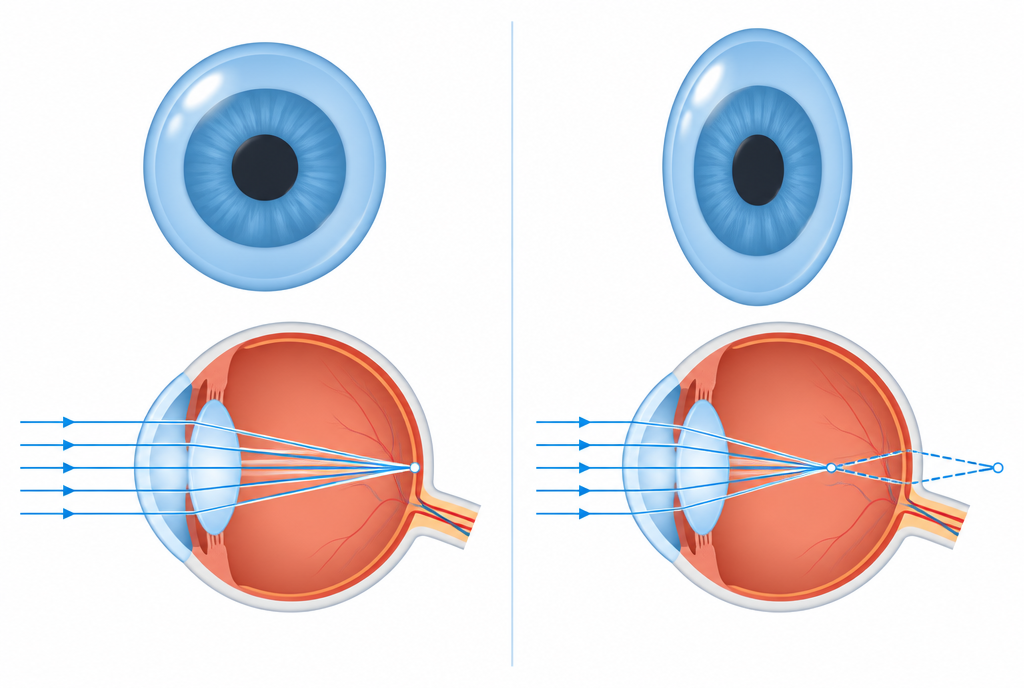
The American Academy of Ophthalmology (AAO) compares a normal eye to a basketball, evenly round in every direction. An eye with astigmatism is shaped more like an egg or a rugby ball. It curves more steeply in one direction than in the other, so light passing through it does not come to a single point. Part of the image focuses in front of the retina and part behind it. The result is blur or distortion at both near and far distances, sometimes with squinting, eye discomfort or headaches.
A few facts that patients often ask about:
- Astigmatism is very common, and it often comes together with nearsightedness or farsightedness. That is why prescriptions often include it.
- It can come from the cornea or from the lens inside the eye. The tendency to have it runs in families. It can also follow an eye injury, eye disease or eye surgery.
- Reading in dim light or sitting close to the television does not cause it. The AAO calls that a myth.
- It can change slowly over the years, especially as the eye ages. It may increase, decrease or stay the same.
Reading the astigmatism numbers on your prescription
A glasses or contact lens prescription usually has three numbers for each eye. The first describes nearsightedness or farsightedness. The other two describe astigmatism.
- Sphere (SPH): nearsightedness (a minus number) or farsightedness (a plus number). A bigger number means a stronger prescription.
- Cylinder (CYL): how much astigmatism you have, measured in diopters. Zero means none. The more the eye resembles a rugby ball rather than a ball, the larger this number.
- Axis: the direction of the astigmatism, written in degrees from 0 to 180. Picture the eye as a map on a wall: 90 is the line running up and down, and 180 is the line running across.
Two practical points. First, eye doctors and optometrists sometimes write astigmatism in different ways, so two correct prescriptions for the same eye can look different on paper. Do not compare numbers from different clinics and conclude that your astigmatism has jumped. Send copies of all of them and let the clinic read them. Second, the cylinder number shows how much astigmatism the whole eye has. It does not show where it comes from or whether its pattern is even. Those answers need the corneal measurements described below.
How each type of treatment deals with astigmatism
The table summarises the general approach of each method. It describes what published medical guidance and our own procedure pages say, not which option suits you.
| Method | How astigmatism is corrected | What the examination has to confirm |
|---|---|---|
| LASIK (flap-based laser) | A thin flap is lifted and an excimer laser reshapes the cornea underneath so that its curve becomes more even | Enough corneal thickness, a healthy corneal shape, and an amount of astigmatism within the treatable range |
| Lenticule extraction (SMILE-type, small incision) | A femtosecond laser shapes a thin lens-shaped piece of tissue inside the cornea that includes the astigmatism correction. It is removed through a small opening | The same corneal checks, and whether your amount of astigmatism falls within the range for that method |
| Surface laser (LASEK, PRK) | The thin outer layer of the cornea is moved aside or removed, and the laser reshapes the surface. The outer layer then grows back | Our surface laser page describes it as often considered for thinner corneas or some flatter or less regular corneal shapes. Thickness and shape are still assessed |
| Implantable lens, toric version (ICL) | A lens with a built-in astigmatism correction is placed inside the eye, in front of the natural lens, lined up with the axis of your astigmatism | Eye measurements for lens size and power. The lens is chosen and prepared for your eye, and its position is checked after surgery |
| Toric lens in cataract or lens surgery | The natural lens is replaced by an artificial lens that also corrects astigmatism | Mainly for people with cataract or age-related near-vision problems, after an examination of eye health and daily needs |
Each method can treat astigmatism only within a certain range, and that range depends on the method, the device used and the rest of your measurements. We do not quote a number here, because a number on its own cannot tell you whether you are suitable. The AAO lists extreme levels of astigmatism among the reasons someone may not be a candidate for LASIK. It also describes implantable lenses as an option that can treat astigmatism and that may suit some people with irregular corneas who are not candidates for LASIK or SMILE.
Glasses and contact lenses remain a valid way to correct astigmatism. The AAO notes that no one correction is right for everyone. The right choice is the one that suits your vision needs and the way you live.
Even or irregular: why the corneal map matters
In regular astigmatism, the cornea is steeper in one direction and flatter in the other, in an even, predictable pattern. This is the kind that laser treatment plans and toric lenses are designed around.
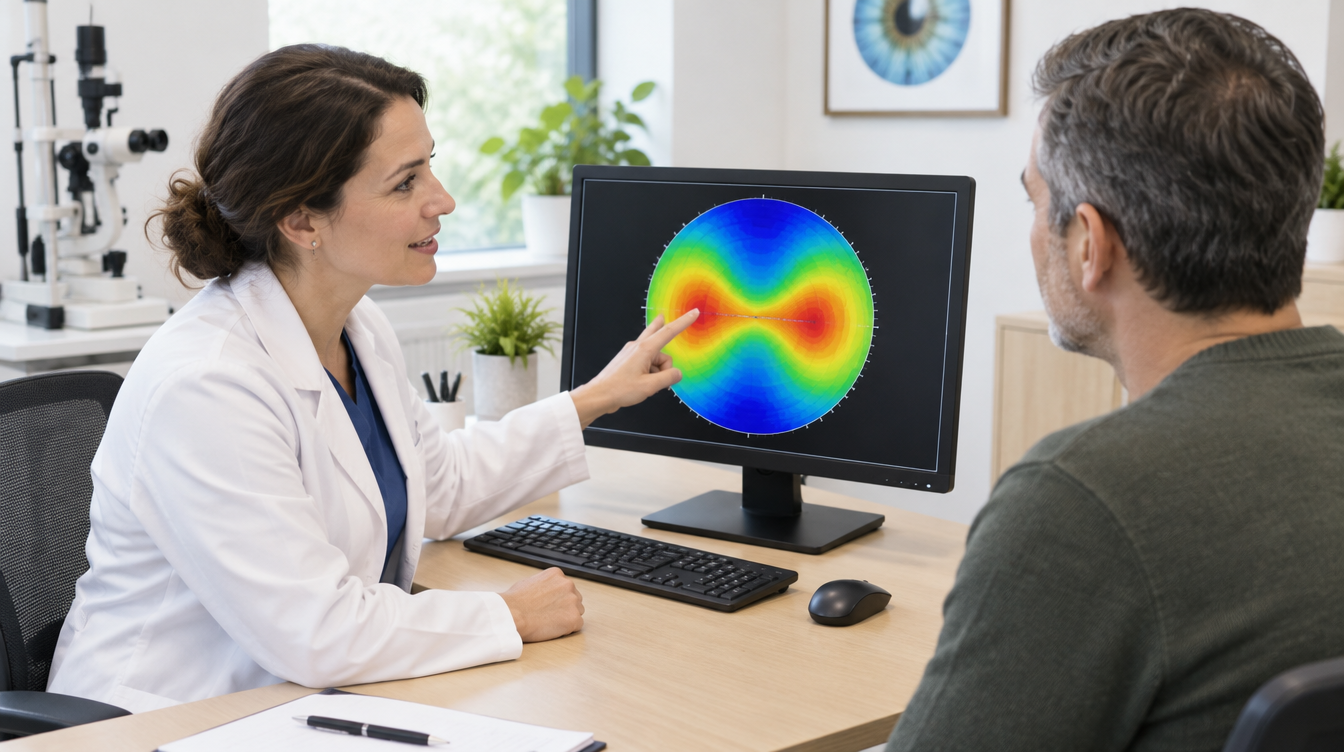
Irregular astigmatism is uneven. The curve changes in patches rather than in one smooth direction. It can follow a corneal scar from an old injury or infection, a growth on the eye surface or previous eye surgery. It is also a feature of keratoconus, a condition in which the cornea gradually thins and bulges forward into a cone shape. Keratoconus is one of the conditions the AAO lists as a reason someone is not a candidate for LASIK.
Early keratoconus may cause only mild blur or slight distortion, and the AAO notes that corneal topography helps find early cases. This is a main reason the corneal map is taken before any laser decision, and why our article on what can rule out laser correction puts corneal shape among the findings that can only be made at the examination. Tell the doctor if any of these apply to you:
- Your glasses prescription, especially the astigmatism part, has changed noticeably several times in recent years.
- Straight lines sometimes look bent or wavy.
- Contact lenses that used to fit well have become uncomfortable or no longer fit.
- You rub your eyes often, have eye allergies, or someone in your family has keratoconus.
None of these points means you have a corneal problem. They tell the doctor where to look more closely. If the map does show an irregular pattern, it can change the conversation from "which laser" to "is laser the right approach at all", and lens-based options or non-surgical correction may be discussed instead.
What the examination measures
Our procedure pages state that the in-person examination checks your prescription, the shape and thickness of your cornea, the tear film and your eye health, and that it includes corneal topography and corneal thickness measurement. This table shows what each part contributes to an astigmatism decision.
| Measurement | What it shows about astigmatism | Why it matters for the decision |
|---|---|---|
| Vision chart | How sharply you see at distance, with and without correction | The starting point for comparing options and, later, results |
| Refraction (automated and with a lens device) | Sphere, cylinder and axis for the whole eye | The amount and direction the treatment would need to correct |
| Corneal curvature and corneal topography | A detailed map of the front surface: how much astigmatism sits on the cornea and whether the pattern is even | Separates regular astigmatism from irregular patterns such as early keratoconus |
| Corneal thickness | How much tissue the cornea has across its surface | Laser methods remove tissue, so this sets limits on what is possible |
| Tear film and eye surface | Whether the surface is smooth and well covered by tears | Affects comfort, recovery and how the plan is timed |
| Eye health, including the retina | Conditions elsewhere in the eye | Some findings change or rule out options |
Your surgeon reads the prescription and the corneal map together. The prescription describes the whole eye. The map describes the cornea. Comparing the two helps show whether the astigmatism comes mainly from the cornea or partly from the lens inside the eye, and that can affect which approach makes sense.
What a topography scan is like, as the AAO describes it: you sit with your chin and forehead against rests, facing a bowl lit with rings, and look at a fixed target for a few seconds. Nothing touches your eye. The scan may be repeated a few times to get clear images.
Contact lenses change the shape of the cornea while you wear them, and that change takes time to reverse. Contact lenses for astigmatism are usually toric soft lenses or rigid gas-permeable lenses, and rigid lenses need a longer break. Measurements taken too early describe the lens rather than your eye. See why to stop wearing contact lenses before your exam and ask us for the interval that applies to your lens type.
Questions to ask at your consultation
These questions help turn the measurements into a decision you understand:
- How much astigmatism do I have in each eye, and has it changed compared with my older prescriptions?
- Is my astigmatism regular? Is there anything on my corneal map that concerns you?
- Does my astigmatism come mainly from the cornea, or partly from the lens inside the eye?
- Which options fit my amount and pattern of astigmatism, and which do not, and why?
- If a toric implantable lens is suggested, how is its position checked after surgery, and what happens if it moves?
- Might I still need glasses for some tasks afterwards, such as driving at night?
- If some astigmatism remains or returns over the years, what can be considered then?
- Can I have my results in writing, including the measurements, for my eye doctor at home?
On the lens question: the AAO lists lens shifting as a very low risk after implantable lens surgery, one that applies particularly to people with significant astigmatism. Because a toric lens is lined up with the axis of your astigmatism, ask how its position is monitored at your checks.
Coming from Mongolia: planning around an astigmatism exam
The examination has to happen in person in Seoul. Remote diagnosis is not permitted in Korea, so a prescription sent by message cannot confirm whether you are suitable. You can still prepare in ways that save time once you arrive:

- Send your prescriptions when you enquire. Include your current glasses prescription with all three numbers for each eye, plus older ones if you have them. Changes over the years matter more than any single reading.
- Tell us what contact lenses you wear. Mention whether they are soft, toric soft, rigid or overnight lenses, so the break before the examination can be built into your travel dates.
- Allow time for the measurements. Corneal scans sometimes need repeating to get clear images. Keep your travel plans flexible until the surgeon has assessed your eyes.
- If a toric implantable lens is proposed, plan ahead. The lens is chosen for your eye's size and prescription, and how long it takes to prepare varies. Your coordinator can explain how this affects your dates.
- Keep the next-day check in your plan. Our stay guide schedules the flight home for after the post-operative check.
- Bring your written results home. If an eye doctor in Mongolia will see you later, the numbers from Seoul give them a starting point.
Coordinators can guide you in English, and a Mongolian interpreter can be arranged, so you can ask about your astigmatism numbers in the language you are most comfortable with.
Gangnam Smile Eye Clinic (강남스마일안과) is a vision-correction and cataract clinic on Gangnam-daero, Seoul. This article was written from Gangnam Smile Eye Clinic's published information and the doctors' explanations. It is general information, not a diagnosis or a treatment recommendation for any individual. Whether your astigmatism can be corrected, and by which method, is decided by your surgeon after an in-person examination, and results vary from person to person.
FAQ
Can laser eye surgery correct astigmatism and nearsightedness at the same time?
Often, yes. LASIK, lenticule extraction (SMILE-type surgery) and surface laser (LASEK or PRK) are all used to treat nearsightedness together with astigmatism, and the treatment plan includes both. Each method works only within a certain range of astigmatism, and the cornea has to be thick enough and evenly shaped. The examination confirms whether your measurements fit.
I have high astigmatism. Does that rule out vision correction?
Not necessarily, but it narrows the options. The American Academy of Ophthalmology lists extreme levels of astigmatism among the reasons someone may not be a candidate for LASIK, and it describes implantable lenses as an option that can also treat astigmatism. Which option fits, if any, depends on the amount, the pattern and your corneal measurements, so it cannot be decided from the cylinder number on a prescription.
Does the corneal topography scan touch my eye?
No. You rest your chin and forehead, look at a target inside a lit bowl, and the device takes images for a few seconds. Nothing touches the eye. It may be repeated a few times to get clear images. Stop wearing contact lenses for the interval the clinic gives you beforehand, because lenses change the corneal shape the scan measures.
Can astigmatism come back after it has been corrected?
Astigmatism can change gradually over the years, especially as the eye ages, and some people still have a small remaining prescription after surgery. Further correction may be considered in some cases, but it is not always possible or necessary. Your surgeon assesses the original treatment, the cornea and a new examination before discussing it. Keep your follow-up appointments and your written results.
Can you tell from my prescription whether I am suitable before I travel?
No. Remote diagnosis is not permitted in Korea, and a prescription does not show the shape or thickness of the cornea. Sending your current and older prescriptions still helps us prepare for your visit, plan the time you need and tell you what to bring. Suitability is confirmed only after the in-person examination in Seoul.